Business is increasingly moving to the cloud — but to this day, there is no unified standard for how cloud infrastructure is structured under the hood. As a result, in security assessment projects, you won’t obtain a complete picture using a traditional penetration test where you only check the management plane, public APIs, and the external perimeter.
Our experts have compiled their experience over several years and created a comprehensive guide to cloud platform penetration testing. The first part of the guide, published recently, outlines the general framework of our approach: what layers exist in the cloud and where the trust boundaries between them lie. Key takeaways from this material:
— Finding an RCE inside an isolated client container — this is far from the end goal; it’s merely a starting point. The true value of cloud penetration testing lies in proving that an attacker can cross trust boundaries and reach neighboring tenants or the provider’s internal infrastructure.
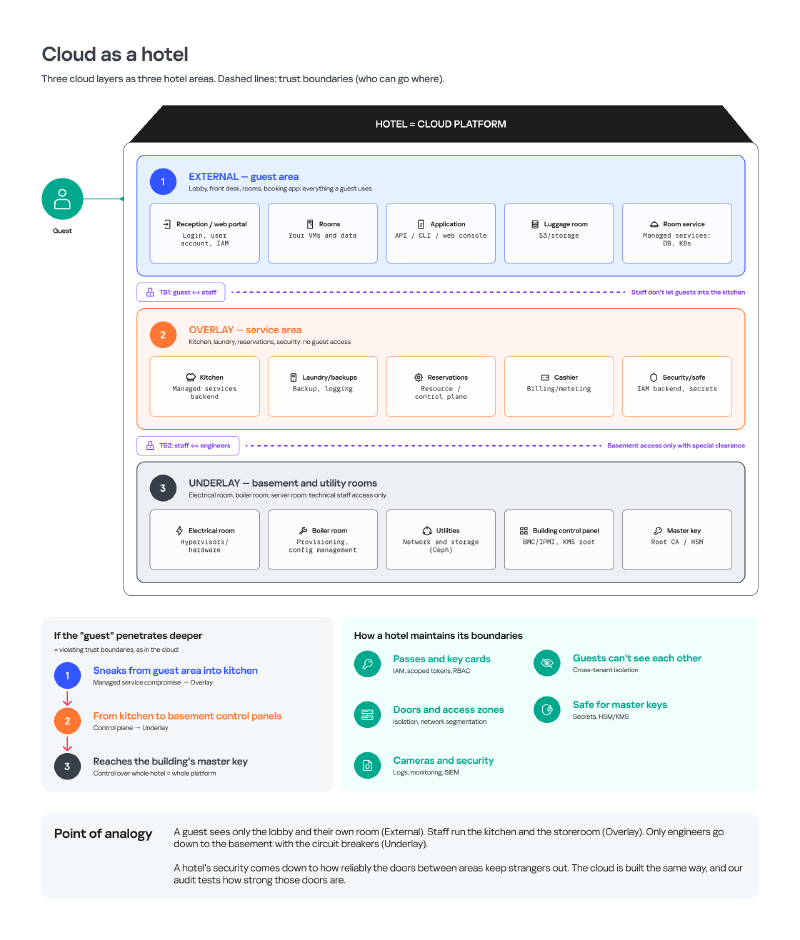
— To avoid getting lost in the architecture, it’s convenient to visualize the cloud as a large hotel with three zones: External (the booking website and your room with a keycard), Overlay (staff-only service areas where billing, backups, and internal APIs operate), and Underlay (engineering infrastructure, hypervisors, and physical hardware).
— Inside a cloud environment, the pentester must literally piece together an architectural puzzle based on indirect clues: processes, routes, and certificates. An apparently identical managed database may run in a standalone virtual machine by one provider, while another provider runs it in a pod within a shared Kubernetes cluster, sitting atop a custom control plane.
— The most interesting bugs hide at service boundaries. For example, the article examines a case where an internal API happily accepts a string containing a null byte (\x00), and a background worker blindly passes it to PostgreSQL.
— Even if the network is completely locked down, a single overly privileged IAM service account token can change everything. It acts like a maid’s master key for every room on the floor, allowing legitimate access to internal APIs through the standard gateway.
— We have thoroughly analyzed four real-world trust boundary bypass vectors: from escaping a Kubernetes pod and a managed database to compromising the entire cloud via routine operations like image imports or backup restores.
— A negative result in cloud penetration testing is still a good result. If escaping your tenant’s boundary proves impossible, it means the security barriers are actually functioning, rather than relying on good faith and architectural assumptions.
Additional details, including architectural indicators of different platforms and rules for safe testing without bringing down production — can be found in the article by Matvey Bukhtoyarov and Denis Stepanov "Transcending the trust boundaries: how a cloud pentest works".